Muslim Rajputs – Who are they?

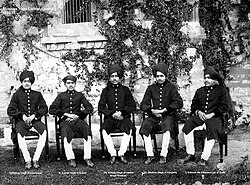
Rajput Princes at Mayo College

Mayo College was opened by British Government to educate Rajput princes and other nobles in 1875 at Ajmer Rajputana. Viewed in this picture are first four Rajput princes and extreme right is Muslim.

Muslim Rajputs (more commonly known as Musalman Rajputs within India and Pakistan) are Rajputs who practice Islam.

Rajputs (Urdu: راجپوت, Hindi: राजपूत) were the warrior and ruling clans of India during the classical period, i.e. 8-13th century. They originally hailed from the historical state of Rajputana, which is in Rajasthan.

The term Rajput is traditionally applied to the original Suryavanshi, Chandravanshi and Agnivanshi clans.

The 1931 census of British India was the last to record caste affiliation in a manner that provides reliable information on Rajput demographics. Any present-day estimates are therefore speculative; they also vary widely.

The 1931 census reported a total of 10.7 million people self-describing as Rajput. Of this population, about 8.6 million people also self-described as being Hindu, about 2.1 million as being Muslim and about 50,000 as being Sikh by religion.

More at Wikipedia

Posted in History, Pakistan, Religion of Abraham | Leave a comment

Brits in the Gulf and a Doctored British Map

It appears that in relation to Britain’s dispute with Iran the British have doctored the maps so it appears the British sailors were arrested in Iraqi waters.

If they were in Iranian waters then they were arrested and if they were in Iraqi waters then they were kidnapped.

Full article

Posted in Conspiracy, Disclosure | Leave a comment

American Liberators shooting at Iraqi Civilians and beating kids – 6 videos

Posted in Disclosure, Video | Leave a comment

Where should the USA invade next?

Posted in Disclosure, Video | Leave a comment

Musharraf at the exit – The Peninsula Online

Musharraf at the exit By AHMED RASHID

IN THE RAPIDLY UNFOLDING CRISIS IN Pakistan, no matter what happens to President Pervez Musharraf – whether he survives politically or not – he is a lame duck. He is unable to rein in Talebanisation in Pakistan or guide the country toward a more democratic future. Since March 9, when Musharraf suspended the chief justice of the Supreme Court, Iftikhar Mohammed Chaudhry, public protests have escalated every day – as has a violent crackdown by the police and intelligence agencies on the media and the nation’s legal fraternity. The legal convolutions about Chaudhry’s dismissal boil down to one simple fact: He was not considered sufficiently reliable to deliver pleasing legal judgments in a year when Musharraf is seeking to extend his presidency by five more years, remain as army chief and hold what would undoubtedly be rigged general elections. Musharraf’s desire to replace Chaudhry with a more pliable judge has badly backfired. After just 10 days of protests, lawyers around the country have made it clear to the senior judiciary that they will not tolerate further legal validations for continued military rule or tolerate Musharraf remaining as president. At least seven judges and a deputy attorney general have resigned in protest.

Across the country, in law offices, in the media, among the opposition parties and other organised sections of civil society, the feeling is growing that Musharraf will have to quit sooner rather than later. After eight years of military rule it appears people have had enough. Moreover, Musharraf is losing control of three key elements that have sustained his rule but are now either distancing themselves or turning on him completely. The first is the ruling Pakistan Muslim League Party, which has acted as the civilian appendage to the military but faces an election and knows that going to bat for the unpopular Musharraf will turn off voters. Party leaders and cabinet ministers are already distancing themselves from him. The second element is the country’s three intelligence agencies, which are at loggerheads over control of Musharraf, Pakistan’s foreign policy, its political process and the media. Military Intelligence and the Inter-Services Intelligence are military agencies, while the largest civilian agency, the Intelligence Bureau, is now run by a military officer. Ironically, Inter-Services Intelligence, the most powerful agency in the country, has been the moderate element urging Musharraf to open up the political system to the opposition parties. The other two agencies are the hard-liners and are urging Musharraf to adopt even tougher measures.

The third loss for Musharraf has been the unqualified international support he has received since the Sept. 11, 2001, attacks. Anger in the US Congress and media, and particularly among members of the Republican Party, toward Musharraf’s dual-track policy in Afghanistan – helping to catch al-Qaida members but backing the Taleban – is making it difficult for President Bush to continue offering Musharraf his blanket support. That was the tough-love message that Vice President Dick Cheney delivered to Musharraf in Islamabad last month: Unless Musharraf goes after the Taleban, the Bush administration can no longer protect him. Any loss of Western support will be critical to the army, which is on an arms-buying spree and depends on annual US military aid of about $300m. Musharraf has balanced the pro- and anti-American factions in the army’s officer corps, but if both sides see him as a lame duck, unable to deliver the goods or stabilise the country, their support will dwindle. Musharraf is now too weak to pursue policies that could keep his back-stabbers in check, restore his credibility at home and abroad, and pursue his agenda of remaining in power for the next five years.

It is far better that he revert to the promise he made when he seized power in 1999: to return the country to democracy. His best course of action would be to say he is not a candidate for president, hold free and fair elections, allow the return of exiled politicians, restore full political rights and gracefully depart with his legacy, which is considerable, intact. It is in the interest of the United States to support such an exit strategy. The military can no longer counter the phenomenal growth of Islamic extremism in Pakistan through offensives alone. What the country needs is greater political consensus and a popularly elected government, and to replace the extortions of the mullahs with the return of day-to-day parliamentary politics. The army created a political vacuum in which extremism has thrived. Pakistan needs a return to civil society and government.

Source

Posted in Disclosure, Pakistan | Leave a comment

Operation Bite: April 6 sneak attack by US forces against Iran planned, Russian military sources warn

Mar 26, 2007, 01:02

WASHINGTON DC, — The long awaited US military attack on Iran is now on track for the first week of April, specifically for 4 am on April 6, the Good Friday opening of Easter weekend, writes the well-known Russian journalist Andrei Uglanov in the Moscow weekly “Argumenty Nedeli.” Uglanov cites Russian military experts close to the Russian General Staff for his account.

The attack is slated to last for 12 hours, according to Uglanov, from 4 am until 4 pm local time. Friday is the sabbath in Iran. In the course of the attack, code named Operation Bite, about 20 targets are marked for bombing; the list includes uranium enrichment facilities, research centers, and laboratories.

Decide for yourself. Read the full article.

Posted in Conspiracy, Disclosure, Iran | 3 Comments

Is the American Empire on the Brink of Collapse? By Mark Karlin

By Mark Karlin, BuzzFlash

http://www.alternet.org/story/49603/

I believe that we’re close to a tipping point right now. What happened to the Soviet Union between 1989 and 1991 could easily be happening to us for essentially the same reasons. Imperial overreach, inability to reform, rigid economic ideology. … The world’s balance of power didn’t change one iota on September 11, 2001. The only way we could lose the power and influence we had at that time was through our own actions, and that’s what we did.

— Chalmers Johnson, author of Nemesis: The Last Days of the American Republic

Has our “leadership” traded democracy for empire? Have their over-bloated egos convinced them that they are the world’s newly crowned colonial kings? Author Chalmers Johnson is certainly not given to wearing rose-colored glasses. As he concludes in his newest book, Nemesis: “… my country is launched on a dangerous path that it must abandon or else face the consequences.”

Johnson’s well-argued, persuasive argument draws on the economic, military, and political lessons of the past, which may be just what’s needed to wake up Americans in time to change course. In this interview, he explained his hopes and fears for contemporary America.

* * *

Mark Karlin: You’ve written a three-part series of books on the United States as an empire. The first was called Blowback. The second is The Sorrows of the Empire. And, now, Nemesis: The Last Days of the American Republic. That’s kind of a doomsday declension there.

Chalmers Johnson: I guess you could say that. It’s inadvertent. I didn’t set out to write three volumes. I don’t know whether Gibbons set out to write The Decline and the Fall of the Roman Empire. But one led to the other.

The first was written well before 9/11, and it was concerned with what I perceived to be the American public’s lack of understanding that most of the foreign policy problems of the 21st century were going to be things left over from the Cold War. Above all, I argue that our numerous clandestine activities, some of which are almost totally disreputable, will come back to haunt us.

The second book followed on the first, in that it was a broad analysis of what I called our military-based empire, an empire of 737 American military bases in over 130 countries around the world. That number is the official Pentagon count. They are genuine military bases. They’re very extensive. They are not, as some defenders of the Pentagon like to say, just Marine guards. We haven’t got 700 embassies around the world. The Sorrows of Empire was written as we were preparing for our invasion of Iraq, and it was published virtually on the day that we invaded.

Karlin: And now Nemesis is your cataclysmic conclusion. Not long ago, it was considered sort of radical to say that America is a neo-colonial empire. But you embrace that concept in many ways.

Johnson: Right.

Karlin: The perspective in much of the neocon writing, in The Weekly Standard, for instance, is that America is an empire. It’s a superpower. It can take whatever it wants. Basically, the rule of thumb becomes, if you challenge the U.S. assertion of military control and dominance, you’re an enemy of the United States. You don’t have to threaten the United States, but merely oppose the imposition of the military authority.

Johnson: Quite true. The roots of this military empire go back, of course, to World War II, which is when we conquered Germany, Japan, Italy, places of that sort, and did not withdraw after the war was over. We’ve been in Okinawa, for example, ever since 1945. The people there have been fighting against us ever since 1945, in three major revolts — they hate it.

But the critical point comes with the collapse of the Soviet Union. Paul Wolfowitz, who was then in the Department of Defense working for Dick Cheney in the first Bush administration, wrote that our policy now is to prevent any nation, or combination of nations, from ever having the kind of power that could challenge us in any way militarily.

This is when we really invite “Nemesis,” the goddess of retribution, vengeance, and hubris, into our midst by proclaiming that we “won” the Cold War. It’s not at all clear that we’ve won the Cold War. Probably, we and the U.S.S.R. lost it, but they lost it first and harder because they were always poorer than we were. The assumption was that we were now the global superpower; we were the lone superpower; we were a new Rome. We could do anything we wanted to. We could dominate the world through military force.

This is as clear a statement of imperial intent as I think one could imagine, and it is what leads to such radical ideas as war as a choice, preventive war, wars such as that in Iraq, which was essentially to expand the empire by providing a new stable base for us in the Middle East, having lost Iran in 1979, and having so antagonized the Saudis that they were no longer allowing us to use our bases there the way we like.

So, yes, I think the word imperialism is appropriate here, but not in the sense of colonization of the world. I’m meaning imperialism in the sense of, for example, the Soviet empire in Eastern Europe throughout the Cold War after World War II. That is, we dominate places militarily, we insist on local satellite-type governments that are subservient to us, that follow our orders and report to us when we ask them to. Yet we have troops based in their territories. They are part of our global longevity.

Karlin: We’ve heard both Bush and Cheney repeat their mantra that the troops won’t come home until our mission is accomplished, until we achieve victory. It’s somewhat fascinating, in a very tragic sort of way, to try to figure out what the heck these guys are talking about. We have seen from both of them so many different missions publicly stated. First it was weapons of mass destruction. Then it was regime change. When we changed the regime and found out there were no weapons of mass destruction, we suddenly developed new missions.

Johnson: Right.

Karlin: Now it’s not clear what the mission is. Bush just says let’s complete the mission. I’ve speculated on my site Buzzflash that this is sort of a policy of white man’s rule, coming from the days of the Confederacy, where, if you were a white male, you were entitled to run a plantation, or whip your slave. You were the head of the household, no matter what.

Johnson: I wouldn’t put it in racist terms, but you’re quite right. The political philosopher Hannah Arendt argued that at the root of all imperialism, there has to be a racist view.

Karlin: When Bush says we have to accomplish the mission, or Cheney says we have to achieve victory, the question hangs out there as to what our mission is now? And what could possibly be victory in these circumstances? To them, mission or victory mainly means that we are perceived as winning and Iraq remains under our control.

Johnson: I believe that’s absolutely true. It’s one of the reasons why we didn’t have a withdrawal strategy from Iraq — we didn’t intend to leave. Several people who retired from the Pentagon in protest at the start of the war — I’m thinking of Lieutenant Colonel Frank Hoffman particularly — have testified that the purpose of the invasion was to establish a new, stable pillar of power for the United States in the Middle East. We had lost our main two bases of power in the region — Iran, which we lost in 1979 because of the revolution against the Shah, whom we ourselves placed in power — and then Saudi Arabia, because of the serious blunder made after the first Gulf War — the placing of American Air Force and ground troops in Saudi Arabia after 1991. That was unnecessary. It’s stupid. We do not have an obligation to defend the government of Saudi Arabia. It was deeply resented by any number of sincere Saudi patriots, including former asset and colleague, Osama bin Laden. Their reaction was that the regime that is charged with the defense of the two most sacred sites of Islam — Mecca and Medina — should not rely upon foreign infidels who know next to nothing about our religion and our background.

The result was that, over the 1990s and going into the 2000s, the Saudis began to restrict the uses we had of Prince Sultan Air Base at Riyadh. They became so restricted that, finally, in the invasion of Iraq in 2003, we moved our main headquarters to Qatar and conducted the war from there. This left us, however, with only the numerous small bases we have in the Persian Gulf. But these are in rather fragile countries.

Iraq was the place of choice, to these characters, who knew virtually nothing about the Middle East. Spoke not a word of Arabic or knew even the history of it. Iraq was the one they picked out because it’s the second largest source of oil on earth, and it looked like an easy conquest.

We now know that the President himself didn’t understand the difference between Shia and Sunni Islam — that he did not appreciate that Saddam Hussein’s regime was a minority Sunni dictatorship over the majority Shia population. That once you brought about regime change there, the inevitable result would be unleashing the Shia population, who had previously been suppressed, to run their country, and that they would align themselves with the largest Shia power of all, a Shia superpower, namely, Iran, right next door, where most of their leaders had spent the period of the Saddam Hussein dictatorship.

That’s essentially what’s happened. It’s hard to imagine how this served our interests, given the deep hostility between Iran and the United States ever since we started interfering in that country back in 1953. It is hard to imagine how this served the interests of Israel, in that it gave Shia support there. Support from Iran now spreads throughout the Middle East to Hezbollah, Hamas, and other organizations. And it leads to a contradiction in terms of what we’re doing there. At times, we seem to be trying to restore Sunni rule, so that we can bring about some peace. On the other hand, we have no choice but to support the majority power because of our propaganda about supporting democracy at the point of an assault rifle.

Karlin: In Nemesis you draw comparisons to the Roman empire. As you point out, with the collapse of the Soviet Union, we became the most powerful nation, at least in our self-perception. But in terms of our economy, we are at the mercy of all the countries that are keeping our economy afloat through loans. Militarily, we have the most powerful weapons, but this seems to have done nothing for us in Iraq.

Johnson: Nothing at all. In fact, sticking to Iraq just for a moment, one of the most absurd things is the fact that we have a defense budget that’s larger than all other defense budgets on earth. This army of 150,000 troops that we’ve sent to Iraq — a country with the GDP of Louisiana, I’d say — they’ve been stopped by 20,000 insurgents. This is a scandal and a discrediting of the military, the Pentagon, and the strategies we’ve pursued.

But the broad argument that I’m trying to make in Nemesis is that history tells us there’s no more unstable, critical configuration than the combination of domestic democracy and foreign empire. You can be one or the other. You can be a democratic country, as we have claimed in the past to be, based on our Constitution. Or you can be an empire. But you can’t be both.

The classic example is the Roman republic, on which our country was, in many respects, modeled. They decided, largely through the influence of militarism, to retain their empire. Having decided to retain it, they then lost their democracy due to military intervention in politics after the assassination of Julius Caesar and the coming to power of military dictators. They were termed Roman emperors, but they were essentially military dictators.

There is an alternative model that I advocate in the book. It’s not as clear-cut an example, but it is certainly one that’s relevant, and that is Great Britain after World War II. After the spectacular war against Nazism, it was brought home to the British that if they were going to retain the jewel in the crown of their empire, namely India, with its huge, vast population, it could do so. It could keep people under its control through military force. They’d used that often enough in India, as it was.

In light of the Nazi experience, though, it now seemed almost impossible to go in that direction. Britain realized that to retain its empire, it would have to become a tyranny domestically. It chose, in my view, to give up its empire. It didn’t do it beautifully, and we see imperialistic atavisms all the time, Tony Blair being the best example. But it chose to give up its empire in order to retain its democracy.

The causative issue is militarism. Imperialism, by definition, requires military force. It requires huge standing armies. It requires a large military-industrial complex. It requires the willingness to use force regularly. Imperialism is a pure form of tyranny. It never rules through consent, any more than we do in Iraq today.

The power of the military establishment is what threatens the separation of powers on which our Constitution is based. The Constitution, the chief bulwark against tyranny and dictatorship, separates the executive and legislative and judicial branches. It does not concentrate power in the executive branch, or concentrate money there, or secrecy.

The two most famous warnings in the history of our country address militarism — namely George Washington’s farewell address, read at the opening of every session of Congress, and Eisenhower’s speech. Washington spoke of the greatest enemy of liberty as being standing armies. He said they were the particular enemy of republican liberties. He was not opposed to defending the country; he was talking about standing armies, as distinct from armies raised to defend the country in a time of national emergency. It was standing armies, Washington argued, that overbalance the separation of powers, that serve the presidency and destroy federalism.

The next great warning, which was even more striking, were the words of Dwight Eisenhower in 1961. He spoke of the military-industrial complex and its unwarranted, unchecked, unsupervised power and the enormous damage it was doing. This is what I’m talking about in Nemesis, and why I use this, as you put it, very apocalyptic subtitle.

But I do mean it. I believe that we’re close to a tipping point right now. What happened to the Soviet Union between 1989 and 1991 could easily be happening to us for essentially the same reasons. Imperial overreach, inability to reform, rigid economic ideology. And we have, as you know, also very serious economic dependencies on the rest of the world now. We are a wholly indebted country. We’re not paying for the things we’re doing. The sort of news we saw in recent days in the Stock Exchange is entirely predictable.

Karlin: Is the Middle East intervention — Iraq, and the desire to nuke Iran — is this empire building in the guise of fighting terrorism?

Johnson: Yes.

Karlin: If there weren’t terrorists, Bush and Cheney would have had to invent them?

Johnson: Absolutely. There’s just no doubt about it. In fact, we have to say that in any historical perspective, that the response of Bush-Cheney to 9/11 was a catastrophe of misjudgment and almost surely based on interests entirely separate from the terrorist attacks. We enhanced Osama bin Laden’s power by declaring war on terrorism, escalating his position. The world’s balance of power didn’t change one iota on September 11th, 2001. The only way we could lose the power and influence we had at that time was through our own actions, and that’s what we did.

Instead of calling it a war on terrorism, we should have called it a national emergency. We should have gone after the terrorists as criminals, as organized crime, because of their attacks on innocent civilians. Tracked them down — we have the capacity to do that — arrested them, extradited them back to the United States, tried them in our courts, and executed them. Had we done that, we would have retained the support of virtually the entire rest of the world, including the Islamic world, as the victims on 9/11.

But we did the opposite. We simply went crazy, and we also refused to acknowledge that the retaliation that came on 9/11 was blow-back. We were partly responsible for what happened, since the people who attacked us were our former allies in the largest single clandestine operation we ever carried out, including Armenians sending into battle of the Mujahideen against the Russians in Afghanistan. Certainly, Osama bin Laden was not unfamiliar to our Central Intelligence Agency. They had been working with him for quite a long time.

It’s in that sense that I think it was a catastrophic error. But the truth is, in retrospect, it doesn’t look like an error at all. They saw it as an opportunity — as a golden opportunity to carry out these sort of mad and speculative schemes that they had been working on throughout the 1990s, dreaming that we were this new Rome that could do anything it wants to.

Karlin: What will collapse first in America, according to your scenario, in the last days of the American republic?

Johnson: I’m not Cassandra. I can’t make a prediction. If I would look at the historical examples, I would say we could expect that a bloated, overgrown military soon would become unaffordable. It would move in and take over. I don’t really expect that to happen, though I certainly should warn you that General Tommy Franks had said publicly in print that in case of another attack like 9/11, he saw no alternative but for the military to assume command of the country.

That would be the Roman answer — having built this huge militaristic world, and becoming increasingly economically dependent on the military-industrial complex domestically. We don’t actually manufacture that much in this country, anymore, except for weapons and munitions. That’s a possibility, that the military does ultimately take over, just as in the Roman republic, with that reliance on standing armies instead of legions raised from common citizens because of threats to the country. Ultimately, ambitious generals, often from the establishment, chose to take over. All they asked for was dictatorship for life, by God, and that’s what they got.

It isn’t inconceivable that one could have a renaissance in popular opinion. And that is needed. We need to rebuild the Constitutional system to overcome that most peculiar of anomalies. We know about the imperial presidency. We know about Dick Cheney’s ambitions. It’s one thing after another. So why is the Congress simply abdicating its role as the main point of oversight, the main source of authority?

I live in the 50th District of California, where Duke Cunningham was sentenced to federal prison for eight and a half years for being the biggest single bribe taker in the history of the U.S. Congress. It’s significant, of course, that the people bribing him were defense contractors. It was a case of us getting crummy weapons, in order simply to line their own pockets.

There’s far too much of that. Not enough has been done about it. We have procedures in this country for dealing with unsatisfactory political leaders, for removing the incompetent from office. It’s called impeachment. Last November, the American public brought the opposition party into power in Congress, and immediately the leaders of the opposition party said impeachment is off the table. Well, if impeachment is off the table, then it may well be that Constitutional democracy is off the table, too.

If you had asked me what I think actually will happen — and again, I cannot foresee the future — the economic news encourages me in this thought. I believe we will stagger along under the façade of constitutional government until we’re overtaken by bankruptcy. Bankruptcy will not mean the literal end of the United States, any more than it did for Germany in 1923, or China in 1948, or Argentina just a few years ago, for 2001 and 2002.

But it would mean a catastrophic shake up of the society, which could conceivably usher in revolution, given the interests that would be damaged in this. It would mean virtually the disappearance of all American influence in international affairs. The rest of the world would be greatly affected, but it would begin to overcome it. We probably would not.

That’s what I think is the most likely development, given the profligacy of our government in spending money that it doesn’t have, in borrowing it from the Chinese and the Japanese, and the defense budgets that are simply serving the interest of the military-industrial complex.

Karlin: Polling has shown that most Americans want some sort of withdrawal from Iraq based on timetables. They want this war over. The Democratic electoral victory was perceived to be a victory to close down the Iraq war. The majority of Iraqis support attacks on American soldiers. Why is Bush talking about trying to save Iraq from the terrorists, if 62% support attacks on American soldiers?

Johnson: That’s exactly the point, I think. He’s not making sense. They’re putting out hot air, a smoke screen, visions, such things as the longing for democracy, as if American G.I.s are going to bring democracy to anybody. They’re disguising their real intent. We see it in their almost total inability ever to say that they do not intend to keep permanent bases, when you’ve seen the largest military bases, air bases with huge double runways, strategically located around the country. Never once do they say, that’s not our intent. And the Air Force occasionally let slip that we expect to be there for at least a couple more decades.

But the American establishment, which certainly includes the Congressional and judicial establishment, has accepted the idea that we are the lone superpower, that we can do anything we want to. Although we’ve always been a superpower since World War II — we’ve easily been the world’s largest nation — we didn’t behave in that stupid manner. That’s in part why I entitled my book Nemesis. She is the punisher of hubris and arrogance.

The public is on the receiving end, in terms of the declining jobs, the lower quality of life in America, and supplying the troops for the wars of choice that Bush and Condoleezza Rice have invented — the public is beginning to get the idea. They understand it in a natural way.

That is one reason the military so much prefers the volunteer army, since 1973, as distinct from conscription. Conscription does mean a citizen army. You know why you’re there. When I was in the Navy in the Korean War, it was an obligation of citizenship, it was not as it is today. Service today in our armed forces is a career choice, a decision about how to make your living. That alters things a great deal.

It makes it easier for the officers. Everybody who was ever in the armed forces knows that, with a citizen army, the people are very sensitive to whether the officers are lying, or whether they know what they’re doing, whether the strategy makes any sense or not. There’s a degree of fairness at work. The Vietnam war was certainly a working-class war. The total number of Yale graduates killed in Vietnam was one, and that is a fact.

So, yes, you could conceivably imagine a renaissance of public demand to take back the Congress, reconstitute it, reform it. Kick out the elites that serve vested interests. They’re in both parties.

But I don’t really expect that to happen. I think it’s almost impossible to imagine mobilizing that kind of public, given the conglomerate control of the media in America, basically for purposes of advertising revenue.

At the same time, I am very much aware that the Internet is a new source of information. It’s radically active. There are lots of people using it. And the public is alive. I’ve now published three books, this inadvertent trilogy. I notice a much more positive response to this last book, Nemesis, than to the first two, when you go into public to talk about it at the bookstore or at a university, or at a Democratic club. The people are worried to death about the way the country is going, the way it’s governed, and above all, what they see as having happened. The political system has failed. We allowed it — we lost oversight. If the price of liberty is eternal vigilance, we have been anything but vigilant.

That’s what Eisenhower warned us against. It’s now here on our doorstep. We’re close to the tipping point. And I don’t really expect it to be reversed. But at the same time, that’s precisely why you and I are talking to each other. We still do believe that there’s a possibility of mobilizing inattentive citizens to reclaim the Congress and clean it up.

Karlin: You mentioned earlier that the CIA at one time cooperated with the mujahideen, and particularly Osama bin Laden.

Johnson: Right.

Karlin: He was, in essence, an intelligence and military asset for the United States in its effort to wound the Soviets in Afghanistan.

Johnson: Right.

Karlin: The effort was successful, in large part, because of a guerilla operation in which foreign fighters, including Osama bin Laden, who is from Saudi Arabia, fought on behalf of a Muslim nation against what was considered an imperial invader from the north — Russia. And Russia finally withdrew.

Johnson: Right. What happened in Afghanistan contributed ultimately to the collapse and dissolution of the Soviet Union.

Karlin: Exactly. It was one of the major dominos leading to the collapse of the Soviet Union as an empire. And it was imperial hubris which caused them to think they could subdue Afghanistan.

Johnson: Right.

Karlin: Now my question is this: Is Iraq America’s Afghanistan?

Johnson: It is perfectly possible that it will prove to be. Let me, just for once, give the Pentagon credit instead of criticizing it. I’ve always preferred their phrase “asymmetric warfare” for terrorism. Terrorism is a wrong word. It’s a pejorative term. It’s used to attack other people. We don’t recognize the amount of terrorism we ourselves perpetuate, particularly from the air. But asymmetric warfare means the warfare of the poor, of the people who must rely upon ambushes and traps, and knowing their own country. That’s what the Soviet Union ran into.

The fact that we are again repeating that — you simply have to wonder whatever happened to Tony Blair? Is he an educated Englishman or not? Doesn’t he know what happened to England in Afghanistan in the 19th Century, where the Afghans wiped them out? They would leave one single Englishman and send him back to the Khyber Pass to inform the army in India what had happened. We’re back there again, and there’s no doubt that we’re going to be facing something very much like what the Soviet Union faced, in this coming summer.

It’s absurd to listen to our people talk about how they had won the Afghan war. Basically what they did was to re-ignite the civil war by aiding the most corrupt figures in the country, namely the Northern Alliance of warlords, and provide them with airpower. It was anything but a victory, and I would hate to invest much in the Karzai regime for longevity.

So, yes, it is perfectly possible that we have come up against our genuine nemesis in the Middle East. We have created an economy totally dependent on oil. There’s our insane belief that we can dominate the world through superior task forces, cruise missiles, and things of this sort. And we still claim that this is democracy.

The very idea — we’ve seen the pictures of Americans kicking down the door of a private home, rushing in, usually walking all over Arabic rugs in their dirty boots, and pointing assault rifles at cowering women and children, carrying a few men off with their arms tied behind their back and hoods over their heads. Then we claim that this is bringing democracy to Iraq? We shouldn’t be surprised that many Iraqis say it’s okay to kill Americans.

That’s what’s going on in Iraq. We know we’re going to lose it, just as we did in Vietnam. At least the public is sensing that, once again raising the hopes that democracy is not an insane form of government. The public may not be as well-informed as it ought to be, but it seems to be better informed than the elites in Washington, D.C.

Mark Karlin is the editor of buzzflash.com.
Posted in Disclosure, Economics | Leave a comment

Meen Erhabe – Dam (Who’s the terrorist?)

Palestinian Hip Hop

Alternative Video

Posted in Disclosure, Video | Leave a comment

Another Civil War in Lebanon? – Will Hezbollah Hand Israel Its 6th Defeat? – Franklin Lamb

A recent poll in Lebanon suggests deep pessimism about the chances of avoiding another civil war. Plenty of ‘wise owls’ here think civil war is just a matter of time.

No less an oracle than Tarek, the doorman at the Alexandria Hotel in Ashhifyeh, where the Israeli Military Command had it’s HQ during its 1982 invasion says Civil war is certain. So does the sous-chef at Chez Paul’s where Sharon, Bashir Gemayel and Eli Hobeika used to meet and discuss ‘business’. And many in Lebanon’s Parliament agree.

For months now large wooden crates have been arriving in various locals in East Beirut and the mountains and hurriedly carried into buildings and various party Headquarters, in violation of the 1989 Taif Accords which required local militias to disarm. (Rafik Hariri exempted Hezbollah from Taif arguing that Hezbollah was not a militia but the Lebanese resistance force since it only used its weapons against Israel)

What’s in those boxes? Are they weapons? If so, who paid for them? Hard to blame Iran and Syria this time since the recipients are their sworn enemies and are itching to fight them both, or more precisely, have Israel or the US act on their behalf.

What about all that promised Bush administration cash and weaponry to shore up the Siniora regime? More than 200 million worth? It there a glitch with the shipping agent and is some of it is going to local addresses other than the “new robust Lebanese army”?

To know for sure, one would want to walk around the Gemezzeh neighborhood in east Beirut around 2 in the morning near the rebuilt Phalange Party HQ.where Baschir Gemeyal was blown up on September 14, 1982 and nose around a bit..

And what’s that frenetic activity behind the Walid Jumblatt’s estate at El Moukhtara in the Chouf.? It has increased since his long meeting with GW Bush a couple of weeks ago.

And those fine new military style boots and swagger one sees among some of Saad Hariri’s March 14 movement young men. Armani or US Army or Israeli issue?

Civil war may well be coming to Lebanon and there is currently plenty of sectarian tension and hatred in Lebanon . Some surfaced in late January when three Hezbollah supporters were killed. When the beautiful widow and young children of 29 year old Adnan Shamas, who was ambushed as he walked home following a visit to the opposition created ‘tent city’ in downtown Beirut, appeared at his funeral there were calls of “blood for blood.”

Sabra-Shatilla massacre participant Samir Geagea, now the leader of the Lebanese Forces Militia and recently feted in Washington DC, beats his chest and taunts Hezbollah’s Secretary-General with threats like “Don’t you dare think Hassan Nassrallah that Beirut is Haifa (referring to the July War) or else Lebanon is headed for the worst.”

Some in the opposition dismiss the Siniora government as nothing more than ‘an organized crime syndicate that wants to turn Lebanon into another Iraq,’ as Talal Arslan, an anti-government Druze leader (breaking ranks with Jumblatt) recently roared. Many accuse the government of functioning as agents of Israel and the Bush administration and demand early elections and a greater share of government posts for the growing anti-government coalition.

Other observers are concluding that Israel and the Bush administration must foment a civil war in order not to ‘lose’ Lebanon and be driven from the region.

Pro-Israel “tink tanks” (Robert Fisk’s label) argue that having created a disaster for both the US and Israel in Iraq and Afghanistan, and having failed miserably to destroy, much less seriously damage. Hezbollah during the July War, both Olmert and Bush desperately need a Lebanese civil war

Their reasoning is that if Bush and Olmert can provoke Hezbollah into turning its guns on Lebanese rivals, which it has never done and refuses to do,(Nasrallah recently declaring that “they can kill 1,000 of the opposition and we will still refuse to participate in a civil war”) the US and Israel can invade, destroy the Lebanese resistance and set up another ‘more sustainable’ government, to borrow a pet term from Condoleezza Rice.

Other objectives expected to be achieve by another Lebanese Civil War are to restore Israel’s deterrent credibility, intimidate the region and occupied territories, create a opening to attack Syria and conceivably go for a spectacular Trifecta and bomb Iran as well.

The other side of the coin.

Hassan Nassrallah and his allies have vowed to prevent a Civil War. In this goal they have the support of elements (if not a majority) in all the confessions and political parties.

Hezbollah has a habit to defeating Israel on the battle field and increasingly in political circles and they may just prevail in preventing a civil war.

Five brief examples:

1. The April 30, 1985 Israel withdrawal from Sidon, Tyre, Nabatieh, and some Western Bekaa villages were the direct result of military pressure from a new organization which was publicly announced on February 16, 1985 and calling itself Hezbollah. Interestingly the same day Hezbollah went public Israel began its withdrawal and it was Hezbollah’s first victory over the Israeli military.

2. July 1993. Israel’s “operation accountability”. Same Israeli goals. Destroy Hezbollah, break its connection with the populace and pressure the Lebanese government to fight Hezbollah. The UN counted 1,224 air raids and more than 28,000 US shells fired into Lebanon by Israel, killing more than 150 civilians, wounding more than 500 and displacing more than 200,000 from 120 south Lebanon villages. In retaliation Hezbollah fired Katusha rockets for 10 hours into Galilee settlements creating what Agence France Press of July 25, 1993 called a ‘hell of shelling” Israel had enough and contacted Washington to arrange a ceasefire.

3. April 11, 1996 Israel’s ‘Operation Grapes of Wrath’. Same Israeli goals. Israel attacked Tallat al-Kayyal in Baalbek and expanded its attack the next against the Lebanese army base in Tyre and neighborhoods in Beirut. Israel killed more than 250 civilians. Hundreds of thousands were displaced, more than 7,000 homes partially or completely destroyed.

Hezbollah had planned well and Katyusha rockets were fired on Israeli forces and settlements on a daily basis. As in 1993, Israel asked the Clinton administration to have Warren Christopher arrange a ceasefire which began at 6 pm on April 27, 1996. Hezbollah’s victory cost Shimon Peres, Clinton’s candidate, to lose the May 29, 1996 Israeli election. Interestingly on March 23, 2007 Peres acknowledged before the Winograd Commission looking into Israel’s performance in the July War, that he would not have invaded Lebanon and tried to defeat Hezbollah in July of 2006. Peres told the Commission: “We can’t defeat Hezbollah unless we burn every inch of Lebanon”.

4. May 24, 2000. After 22 years of occupying more than 10% of Lebanon, Hezbollah forced Israel to withdraw from all but the Shebaa farms in one night, abandoning its planned phased withdrawal as well as its agents, the South Lebanon’s Army. Contrary to Israeli scare tactics, there was no Hezbollah retaliation against Lebanese collaborators. This fact earned Hezbollah the respect of all Lebanon’s confessions, not least, the Christian community.

5. Hezbollah’s victory in the 2006 July war is common knowledge and discussed in the new volume: The Price We Pay: A Quarter Century of Israel’s use of American Weapons in Lebanon, available at ngolebanon@aol.com.

The consequences of these five Israeli defeats have been unacceptable for Israel. Its invincibility myth is now the butt of late night TV jokes. The Hezbollah led Lebanese resistance has caught the imagination of much of the World including the occupied Palestinian territories. Israel and the Bush administration believe the only solution is another Civil War Lebanon so they can destroy Hezbollah. As former US envoy John Bolton made clear to the BBC on March 22, 2007 he also favors ‘another round’.

Bolton is aware of the recent reports sent to the US Senate Intelligence Committee in February, 2007 which suggests that the CIA believes Israel may well cease to exist in its current form by the centenary of the 1947-48 Nakba which led to the establishment of the Jewish state. . The Report predicts a significant increase in the current emigration from Israel mainly to the US, Western Europe and Russia and continuing decline in immigration to Israel. Bolton blames Hezbollah. But a Congressional staff member offered the CIA view on March 21, 2007:

“History teaches us that resistance eventually trumps occupation every time and Israel has never seriously considered a just peace with the Palestinians or its Arab neighbors. There is no rational reason to think that they will now. It’s the Masada syndrome. Fanatics run Israel and they would rather destroy themselves than give back what they stole from the Palestinians”.

“Persia rising, Zionism sinking”! As another Congressional staff member put it.

As Israel continues its nearly daily violations of Lebanese sovereignty, the main concern of the US Intelligence analysts is not a nuclear Iran, but rather how to get Israel’s finger off its 350+ nuclear warheads. Some US Defense Intelligence Agency analysts believe that Israel will indeed try to use its arsenal and that a nuclear holocaust is likely.

Rapture seeking Christian fundamentalists told the March 2007 AIPAC conference in Washington DC that when this happens it will be God’s will and any surviving Jews will then convert to Jesus or burn in hell. Either way works for them.

Few in the US intelligence community doubt that if Israel fires its nuclear arsenal that their targets will include America. Why would Israel not spare the US after 60 years of support including total aid in excess of one trillion dollars? The reason is because Israel sees the American public as getting ” all wobbly” (read: slightly more informed thanks to the diligent efforts of dozens of courageous pro-Palestinian/pro Arab and pro Peace interest groups in the US as well as the Iraq catastrophe) and will sooner rather than later, dump Israel.

Freezing Israel’s nuclear trigger is the question of the hour. Meanwhile, Israel and the Bush administration continue trying to ignite an Iraq style Civil War in Lebanon. Hezbollah and their Christian and Muslim allies are trying to prevent one. Which side will prevail?

Ladies and gentlemen, the bell has sounded for Round Six: Israel vs. Hezbollah. The arena is holding its collective breadth. The outcome is uncertain. To date the score is Hezbollah 5, Israel 0. On the issue of a Civil War in Lebanon, place your bets please.

Franklin Lamb has been in Lebanon researching a book for the past nine months. Hezbollah: a brief Guide for Beginners in expected in early summer, 2007. He can be reached at fplamb@gmail.com

Source

Posted in Disclosure, Lebanon | Leave a comment

Why the West has lost the ideological war against Muslims? – Abid Mustafa

“The West won the world not by the superiority of its ideas or values or religion but rather by its superiority in applying organized violence. Westerners often forget this fact, non-Westerners never do.”Samuel P. Huntington

During his visit to Europe, George Bush emphasised to his European hosts that spreading freedom and democracy was the only way of defeating terrorism in the Middle East and the wider Muslim world. His remarks echo a familiar tenet of his presidency – freedom triumphing over terrorism.

But, by coining the struggle as freedom versus terrorism, the Bush administration has avoided answering some pertinent questions like – What is terrorism? Who are the terrorists? Who is the enemy in the eyes of Bush and his acolytes the neo-conservatives?

The 9/11 Commission (by no means the first) stressed that the term war on terrorism was misleading and recommended that it should be renamed to place greater ideological emphasis against Islam. In October 2001 US General Wesley Clark, said that the US war against terrorism “was a war over Islam” that would define Islam “as either a peaceful or militant” force in society [1]. Yet others have argued that it should be appropriately labelled war against political Islam.

Whatever differences exist amongst America’s political elite over the naming of the war there are few to be found amongst ordinary Americans. Thanks to the Islamaphobic corporate media, most Americans irrespective of their political orientation view the war on terror as a fight against Islam.

The same milieu exits in Europe. The lack of boldness on part of the Europe’s political class to confront Bush on these questions together with the Islamaphobic media has convinced ordinary Europeans that their new enemy is Islam and Muslims who live in their midst

Before 9/11 Muslims long held the view that American intervention in their lands is part of the ongoing struggle between Islam and the West. The aftermath of 9/11 only served to reinforce this view. Today an overwhelming majority of Muslims believe unequivocally that the war terrorism is a war against Islam and Muslims.

Hence, behind Bush’s charade of fighting terrorism the clash between Islam and the West is well and truly under way. This struggle is being fought at several levels. The most important of all is the ideological struggle. The winner of this battle will decide whether the future belongs to Islam or Western secular liberalism.

So the question that now arises is who is winning the battle of ideas? The answer is that the West long ago lost the ideological war against Islam. This due to the following reasons:

1). The West has spent the last two hundred years combating Islamic thoughts in the hope of dissuading Muslims from Islam. This campaign began with the orientalists who studied Islam and attacked its beliefs and rules.

For instance they attacked the divinity of the Quran, jihad, polygamy, the Islamic punishment system and the Caliphate. But despite this organised effort to alienate Muslims from Islam, the West is facing a resurgent Islam both at home and abroad.

In the West, Islam is the fastest growing religion both amongst immigrants and the indigenous community. Between 1989 and 1998 the Islamic population in Europe grew by over 100 percent, to 14 million (approximately 2 percent of the population), according to United Nations statistics [2]. “Within the next 20 years the number of British converts will equal or overtake the immigrant Muslim community that brought the faith here”, says Rose Kendrick the author of a textbook guide to the Koran [3]. America is not immune from this phenomenon. One expert estimates that 25,000 people a year become Muslims in the US; some clerics say they have seen conversion rates quadruple since Sept. 11[4].

Conversion figures aside, the attitudes of Muslims living in the West towards secular liberalism is equally damning. A recent ICM poll surveying Muslim attitudes in Britain published the following results: 81% view freedom of speech as a means of insulting Islam, 61% support the Sharia, 88% want Islam in schools, and 60% do not think they need to integrate.

If this is the outlook of Muslims in one of the main citadels of enlightenment then one can only guess the stance of Muslim world towards secular liberal values. Suffice to say that the West has failed to convince the Muslim masses that Western culture is better than Islam.

2). In the past the West employed the services of modernists such as Rifa’a At-Tahtawi (1801-1873), Jamal Ad-Din Al-Afghani (1838-1897), Muhammad Abduh (1849-1905), Taha Hussein (1889,1973) and Rashid Rida (1865-1935), Syed Ahmad Khan (1817-1898) to spear head their campaign of introducing Western culture under the guise of Islam. The impact of these reformists has not only been nullified but also reversed.

Today’s modernists find themselves in precarious situation. They are despised by Muslims and are seen as instruments of the cultural imperialism undertaking the West’s bidding to defame Islam.

In Western eyes they are viewed as being too Islamic and are no longer entrusted with the responsibility of turning Muslims away from Islam. America’s decision to revoke Tariq Ramadan’s visa and the media outrage at Al-Qardawi’s visit to the UK epitomises West’s mistrust of modernists. On the whole they are discredited and have become irrelevant in the battle of ideas between the West and Islam.

3). The biggest blow dealt by the West against the Islamic world came on March 3rd, 1924, when Britain through her stooge Mustafa Kamal destroyed the Caliphate. Lord Curzon speaking in the House of Commons said, “The point at issue is that Turkey has been destroyed and shall never rise again, because we have destroyed her spiritual power: the Caliphate and Islam. “ Subsequently, the European powers curved up the Islamic lands between them establishing direct colonial rule over the Muslim people.

The Muslim masses for the first time were exposed to Western solutions ranging from economic solutions which plundered their wealth to an educational syllabus which disconnected them from their history, reduced Islam to a mere set of rituals and taught them how to think like Westerners.

Moreover, Islam was effaced from temporal life only to be replaced by a secular rule. Later the West granted pseudo independence to the Muslim countries they had invented and appointed loyal servants to safeguard Western interests and to rule over Muslim people on their behalf.

If the West had thought that eight years of subjugation to secularism would have been enough to deter the Muslim masses from political Islam then they were gravely mistaken. The ferocity and direction of today’s Islamic revival has seized the attention of Western leaders. Vladimir Putin, Tony Blair and Donald Rumsfeld have joined a long chorus of Western leaders in 2004 warning about the dangers of a resurgent Caliphate. This was aptly summed up by Kissinger who said,”…what we call terrorism in the United States, but which is really the uprising of radical Islam against the secular world, and against the democratic world, on behalf of re-establishing a sort of Caliphate [5]”.

4). There is an inherent flaw in the ideology of secularism, which has led to its predictable rejection by the Muslim world. This is because secularism insists on restricting the role of Islam in society to personal worships only. Political decisions about running the society are left to human beings. This directly contradicts the doctrine of Muslims, which considers politics an indivisible part of Islam i.e. to Muslims Islam is politics. Bernard Lewis gave a similar assessment and said, “The absence of native secularism in Islam and the wide spread rejection of an imported secularism inspired by Christian example, may be attributed to certain profound differences of belief and experience in the two religious cultures [6]”.

Furthermore, secularism always leaves a spiritual void, especially when human beings are confronted by problems, which they are unable to solve. Separating God from temporal matters only accentuates this feeling

It is this intellectual weakness that has contributed to the dramatic rise of political Islam under the secular autocratic rule, which pervades much of the Muslim world.

The West should take heed from the inability of communism to dissuade Muslims from Islam. Communism a far deeper ideology than secularism also failed to convince the Muslim masses of materialism and man made laws.

5). The duplicity of the West in promoting Western values across the Muslim world has greatly undermined its credibility. Especially, after September 11, when Western doubles standards reached new heights. It was the episode of Abu Ghraib that revealed the true extent of the Western hypocrisy and hatred towards Muslims.

Western ideas such as freedom, democracy, human rights were given a devastating blow not by Muslims, but by America the so-called defender of liberty. Even the agent rulers in the Muslim world were left gasping and could not shield America from the evil crimes she had committed.

In one swoop, America by its own handiwork had permanently damaged its standing in the Muslim world and had gravely weakened the very ideas that represent the cornerstone of Western civilisation. So much so, that many non-Muslims are questioning the validity of these ideas and the deceitful role played by their governments abroad.

Hence for the very first time, Western governments are faced with the challenge of convincing their own citizens why these values have to be curbed at home, while these values are forcibly thrust upon the Muslim world. Perhaps Westerners should seek solace in the words of Oscar Wilde who said, “Democracy means simply the bludgeoning of the people by the people for the people.”

These are some of the reasons, which have contributed to the Muslim world’s rejection of Western culture and its secular liberal philosophy.

The stark reality facing Western governments today is that the Muslim ummah (Muslim nation) has won the battle of ideas. The chapter of ideological struggle between the Muslim ummah and the West is more or less closed. But the chapter of political struggle between the ummah and the West is still open- albeit for limited period. This is because the West and their surrogates have no political legitimacy left in the Muslim world. These surrogates only survive because of dogged support from Western powers.

Therefore the West and their puppets stand alone in coercing the ummah to accept Western values. While the ummah stands firm rejecting Western culture and calling for the return of a global Islamic state. The two positions are irreconcilable and polarisation in viewpoints between the regimes and its people cannot continue indefinitely.

It is only a matter of time before Muslims overthrow the secular order, which has been unjustly imposed upon them. Sensing the failure of its surrogates to contain political Islam, the West under the pretext of fighting terrorism has sought to re-occupy the Muslim lands in a desperate bid to reinforce its values and to safeguard its material interests.

West’s behaviour towards the Muslim world can be likened to that of a failed schoolteacher. A failed schoolteacher is a person who continues to beat his pupils in the vain hope of imbuing them with the values of the school. Instead, the teacher not only loses control of the class but also brings down the very establishment he is trying to protect.

Indeed Westerners have got far less to fear from the Islamists and more to fear from their own governments who in the name of freedom and democracy are slowly but surely ebbing away at the very foundations of their civilisation.

Notes:

[1]. Wesley K. Clarke speaking on BBC World’s Hardtalk programme, October 29
2001
[2]. Muslims in Europe, The Economist, October 18, 2001.

[3]. The Spread of a World Creed, The Times, November 9 1993

[4]. Islam Attracts Converts by the Thousands, The New York Times, October 22
2001
[5]. Henry Kissinger, Hindustan Times, Nov 2004

[6]. What went wrong?, Bernard Lewis, 2003

Source

Posted in Disclosure, History | 1 Comment