Where’s the money? – Times Online – 10 Aug.08

Asif Ali ZardariPervez Musharraf

THE embattled president of Pakistan, Pervez Musharraf, has been dealt his latest and most serious blow with the accusation from the leader of the ruling party that he misappropriated hundreds of millions of dollars of American aid given for supporting the war on terror.

Asif Ali Zardari, who took over the Pakistan People’s party (PPP) after his wife Benazir Bhutto was assassinated in December last year, made the charge in an interview with The Sunday Times.

He also detailed for the first time Musharraf’s attempts to sabotage his government which, he says, forced him to take the drastic step of demanding his impeachment.

“Our grand old Musharraf has not been passing on all the $1 billion [£520m] a year that the Americans have been giving for the armed forces,” he claimed. “The army has been getting $250m-$300m reimbursement for what they do, but where’s the rest?

“They claim it’s been going in budget support but that’s not the answer. We’re talking about $700m a year missing. The rest has been taken by ‘Mush’ for some scheme or other and we’ve got to find it.”

The alleged misappropriation will form a key part of the charge against Musharraf to be announced tomorrow when parliament is recalled to start impeachment proceedings.

The move has sparked panic in Whitehall and Washington where the nuclear-armed Pakistan is increasingly seen as a far greater danger than Iraq or Afghanistan.

In Pakistan, fear is mixed with widespread support among a public that cannot understand why Musharraf remains as president six months after elections in which his own party was dealt a humiliating defeat.

Accusing Musharraf of mis-using funds is a rare pleasure for the 54-year-old Zardari, whose own name became a byword for corruption during his wife’s first government in 1988-90. He spent 11 years in jail on charges for which he was never convicted.

Zardari claims the American aid may have gone to fund rogue members of the military intelligence, the ISI, who were last week accused by Washington of assisting Taliban and jihadi groups rather than rooting them out.

“We’re looking for the money,” he said. “I think he [Musharraf] has a slush fund being used for this and for some activity for the future.” Zardari also accused the president of economic sabotage and fomenting conflict in Baluchistan and the tribal areas. “They laid so many mines for us,” he said.

“They spent all the money so we would have to borrow; they didn’t pass on the increased price of oil; nor added a single extra megawatt of power in the last 10 years. All these things were deliberately thought out so at the end of day they can turn round and tell the world, ‘Look, democracy doesn’t deliver’, and step back in.”

Zardari was speaking from the house in Islamabad from where Bhutto set off for her last rally. Her assassination turned him from an ostracised figure, blamed by many for her double dismissal from office, to a grieving widower and the country’s most powerful politician.

The road outside is manned by police and his house is guarded by his own protection team of men in black. “I know I’m in danger,” he said. “Whoever killed her wants to kill me.” Inside, the living room is dominated by a life-size picture of Bhutto from that day, garlanded with rose petals and hands raised as she addresses the crowds in Rawalpindi.

Minutes later, as she popped up from the sunroof to wave, she was murdered.

“She’s all around me, I live with her,” Zardari said. “I haven’t touched one thing in her bedroom, her manuscript [of her last book] is lying on her side and I sleep on my side.”

Gesturing at her last photograph, he said: “I think she’s looking at us now and saying, ‘Now tell me, Asif, do you think it’s easy?’” On the wall of the dining room is a framed copy of her handwritten will naming him as her successor. It is dated October 16, just two days before she returned to Pakistan after 8½ years in exile.

It left Zardari as kingmaker but, although the PPP emerged as the largest party, its lack of a majority forced it into a coalition with Bhutto’s long-time rival Nawaz Sharif, leader of the Muslim League.

Sharif’s price for his support was the removal of Musharraf, who ousted him as prime minister in his 1999 coup. He also wanted restoration of the judges who were sacked when Musharraf declared a state of emergency last November.

Last Tuesday Sharif told Zardari that he would withdraw his support for the coalition unless the president was removed. The following night the impeachment plan was announced at a joint press conference. It follows criticism by the United States during the government’s trip to Washington 10 days ago for failing to rein in the intelligence services still supporting the Taliban.

“To say we’re responsible for the country, yes we are, but first get your role model out of the way, remove your most allied of allies,” said Zardari. “They’ve had Musharraf there 10 years, instead of bringing these issues up with him they are trying to bring them up with us today.”

In the meantime the impending impeachment battle has plunged Pakistan into further instability. Zardari said he had been left with no option after Musharraf refused to accept an honourable exit.

“The offer was on the table that you walk and you don’t get prosecuted, but I’ve had no returns so have had no choice but to go along with my partner’s more aggressive stance,” he said.

Musharraf has made it clear that he will fight any such effort. “I’m not afraid; I’ve not learnt fear,” he said in a speech. It is still unclear whether Zardari and Sharif can muster the two-thirds of both houses needed to unseat him. In the meantime, Musharraf still has the power to dissolve parliament.

Zardari warned against such a move, saying: “If he does it, it will be his last verdict against the people, the people’s mandate and against Pakistan.”

Blood honour

THE widower of Benazir Bhutto and their three children are preserving her bedroom in their Dubai home as a shrine and have pledged to give blood in her memory at every birthday and anniversary of her death.

“Our bedroom in Dubai has been locked and I sleep in the next room because the children and I don’t want to lose her scent in the room,” said Asif Ali Zardari.

Zardari wants to turn the house in Karachi he gave her as a wedding present into a museum in her memory. Bhutto left it in her will to their son Bilawal, so father and son are in negotiations.

Source

Posted in Disclosure | Leave a comment

Analysis: President Pervez Musharraf’s last gasp shows how West has failed

General Pervez Musharraf

The move to impeach the Pakistani president is the culmination of a power struggle between the former military chief and the civilian government.

By Isambard Wilkinson

It is a battle that has paralysed Pakistan since Mr Musharraf’s political party lost elections in February.

The governing coalition’s attempt to oust him has raised the prospect of a drawn-out and debilitating wrangle that could plunge Pakistan, and its neighbours, into chaos.

This could dangerously weaken Pakistan, which is already plagued by pro-Taliban militancy and whose people face rapidly escalating fuel and food prices.

The prospects of the nuclear-armed country, which is also a hiding place for al-Qaeda leaders, being rocked by further instability is a mounting concern both for the West and for Pakistan’s neighbours.

Mr Musharraf, who seized power in 1999, stepped down as army chief in November after being re-elected to serve a five-year term as president.

He has said in the past he would resign rather than be dragged through an impeachment process by a parliament filled with enemies.

There is a possibility, however, that he will do as his allies suggest and use the last remaining tools at his disposal – the remnants of a defeated political party and a military intelligence agency – to regain some of his much diminished power.

The United States, which has counted on Mr Musharraf as a linchpin in the fight against al-Qaeda and the Taliban, has yet to offer public support for him since the impeachment announcement. It has only said that the impeachment was an “internal” matter.

Leaders of the Pakistan People’s Party (PPP), which is pushing for impeachment, have tried to persuade Washington that Mr Musharraf has undermined the civilian government and that the country will continue to meander dangerously until he leaves power.

More worryingly for the president, American officials have begun to publicly question Mr Musharraf’s ability or willingness to tackle hardcore militants and his worth has an ally.

A recent New York Times report quoted US officials accusing Pakistani military intelligence of being responsible for a bloody terrorist attack on India’s embassy in Kabul.

But, more ominously, the attempt to impeach Mr Musharraf has exposed the lack of leadership alternatives in Pakistan and the failure of Western policy.

It has prompted the final gasp of a British and US‑backed deal that envisaged Mr Musharraf sharing power with the secular PPP, the party of the late Benazir Bhutto.

The deal was designed to prolong the political life of Mr Musharraf, a military strongman upon whom the West depended for his
co-operation in counter- terrorism, and to restore democracy to Pakistan.

Its ultimate goal was to install a secular, popular, broad-based government that would help counter growing Islamic militancy and that would be willing to take on al-Qaeda in its sanctuary in Pakistan.

The deal must have looked good on paper. However, it was blown apart by several incidents, perhaps predictable, that have left Pakistan on the brink of another political crisis and, according to British security officials, even more fertile
an environment for the propagation of international terrorism.

Last year, Mr Musharraf embarked on a series of hubris-driven, auto- destructive blunders that included sacking the chief justice and imposing a state of emergency.

The deal’s other chief protagonist, Benazir Bhutto, was assassinated, as was widely predicted would happen, in December. Since then Mr Musharraf and Ms Bhutto’s distrusted and discredited widower and political successor, Asif Zardari, have failed to reach agreement on how to govern.

Mr Zardari’s main coalition partner, Nawaz Sharif, the Pakistan Muslim League-N leader, who was ousted from power by Mr Musharraf a decade ago and carries an equally troublesome past, has implacably sought Mr Musharraf’s political scalp.

The popular will may be that Mr Musharraf should go, but few are confident that whoever succeeds him will be up to the task.

The focus is now on the chief of army staff, General Ashfaq Kayani, who has made the well-intentioned, but perhaps ill-fated, statement that he will keep the army out of politics.

Source

Pressure mounts for quick decision – Jang

Musharraf awaits charges before decision to quit – Jang

Impeachment hopes and fears -BBC

Musharraf impeachment discussed

Pakistan press split over Musharraf

President Pervez Musharraf at a ceremony in Karachi in July

President Musharraf retains the power to dissolve parliament

The decision by Pakistan’s governing coalition to begin impeachment proceedings against President Pervez Musharraf aroused a mixed response in the local press.

While both English and Urdu language papers agreed it was time for Mr Musharraf to go, several of the main English-language papers viewed the impeachment bid negatively, describing it as a cynical tussle by politicans vying for Mr Musharraf’s job and pointing out that the government had no long-term strategy.

However, in the Urdu-language press, some papers praised the government for trying to fulfil the expectations of the electorate and working towards a “new Pakistan”.

ENGLISH-LANGUAGE PAKISTAN OBSERVER

The decision of the ruling coalition… amounts to making a plunge into darkness and that too at a time when the country was in dire need of national unity and cohesion to ward off threats to its security and integrity¿ The political turbulence that might accompany the process of impeachment would further poison the atmosphere and accelerate the downslide to the amusement of our enemies.

ENGLISH-LANGUAGE THE NEWS

The politicians shouting for his ouster want him out so that they can tussle for his job – the altruism that apparently drives their efforts is as phoney as most things political in Pakistan; this is about power, who has it and who wields it. At a more humble level it is clear to a majority of ordinary people that the president has gone past his sell-by date.

ENGLISH-LANGUAGE DAWN

Unless something out of the ordinary happens, President Pervez Musharraf’s political fate has been sealed¿ What the PPP and PML-N leaders should know is that President Musharraf’s removal from the scene will merely remove a perceived hindrance in the way of good governance. Unfortunately, there is no evidence that the coalition partners have bothered so far to draw up a comprehensive development strategy focusing on long-and short-term goals.

ENGLISH-LANGUAGE THE NATION

Now that the coalition has decided that the president’s removal from office would precede the judges’ restoration, it is to be hoped it would wholeheartedly work to realise these objectives and succeed¿ Now that the differences between the two major political parties appear set for resolution, it is to be hoped that their leaderships would do all they can to… address the manifold problems of the people.

URDU-LANGUAGE EXPRESS

Pakistan’s ruling parties have agreed to impeach President Musharraf first and then restore the deposed judges. We believe the ruling alliance is… trying to meet the people’s expectations. If any misadventure is attempted by the presidency at this stage, the country will fall into anarchy. Everyone should play a positive role at this juncture.

URDU-LANGUAGE EXPRESS NAWA-I-WAQT

We believe President Musharraf should read the writing on the wall and withdraw honourably. If he is removed in a constitutional manner, he might face a court trial for the Kargil operation and the 2 November imposition of martial law… This would not be a pleasant situation for him.

URDU-LANGUAGE AUSAF

We believe when the judges are restored and the country gets rid of President Musharraf, a new Pakistan will come into being where the ruling junta will address public problems in a better way. It is the right of the people that the coalition government focuses its attention on core issues and buries their mutual differences.

Source

Posted in Pakistan, South Asia | Leave a comment

Haneef mystery thickens – SMH – 30 Jul.08

The Australian Federal Police should be forced to make public its submission to the Clarke Inquiry into the case of Mohamed Haneef, say lawyers for the falsely accused and detained Indian doctor.

The federal police have already made a submission to the inquiry but that document is protected from public scrutiny by a security classification that can only be removed by the agency itself.

The lawyers’ calls come after yesterday’s revelation that police ignored Australian Security Intelligence Organisation in pursuit of the doctor.

ASIO’s submission revealed it “consistently” advised the Howard government and its agencies it had no evidence connecting the Gold Coast-based doctor to a British terrorist plot.

That information was relayed in writing three days before federal police charged the doctor with recklessly supporting terrorism and five days before the former Immigration Minister, Kevin Andrews, stripped Dr Haneef of his visa on “character and national interest grounds” that have never been explained.

Today, Dr Haneef’s lawyer Rod Hodgson reiterated the need for a transparent inquiry.

“If ASIO felt and told everybody, including the AFP, that Dr Haneef was not a security threat, why was Dr Haneef ever charged?” Mr Hodgson said. “One thing the Australian public needs to know is who within the AFP directed the charging of Dr Haneef in the face of advice from Australia’s peak intelligence agency.”

Earlier this week, the head of the inquiry, John Clarke, QC, said a high proportion of material handed in by government departments and agencies carried a security classification which limited the extent of its disclosure.

“Any attempt to secure declassification would confront a hurdle which I regard, practically speaking, as virtually insurmountable,” he said.

The removal of classifications is voluntary and he rejected calls for royal commission powers to force it.

The Australian Federal Police Commissioner, Mick Keelty, has declared there were grounds to treat Dr Haneef as a security risk. Now there are questions as to whether his stance was tenable.

Asked this morning why ASIO could make their submission public and the police couldn’t, a federal police spokeswoman said that was a matter for ASIO.

“We are letting the inquiry run its course,” she said.

Last night, the police told the Herald: “The AFP has always been aware of ASIO’s position on this issue and the AFP will be providing its position on this to the Clarke inquiry and not via the media.”

Today, the inquiry hears from Ramzi Jabbour, the force’s head of counter terrorism. These interviews are closed and transcripts of them will not be made available.

Source

How the Haneef affair became carry on coppers – SMH – 22 Aug.08

Haneef cleared at last – SMH – 30 Aug.08

Haneef ‘happy he’s no longer suspect’ – SMH – 01 Sep.08

Posted in Conspiracy, Redneckia | Leave a comment

Mubarak Hires the Mosque By Rannie Amiri

The English translation of the July 3rd headline in the respected Egyptian daily, Al-Masry Al-Youm (Today’s Egyptian) was long and cumbersome, yet unmistakable:

“Ministry of Interior Calls Scholars to Train State Security Investigation Officers on Combating the Shiite Ideology” (1).

The translation of the translation: Egyptian President Hosni Mubarak is co-opting the scholars of Al-Azhar—its seminary considered to be the highest religious authority in Sunni Islam—to do his sectarian bidding. More disturbingly, Al-Azhar seems willing to comply.

Egypt is now home to approximately 150,000 of the more than one million Iraqis who fled or were driven out of their neighborhoods in the unending aftermath of the 2003 war. A significant number of those in Egypt, if not the majority, are Shiite Muslims. What apparently attracted the state’s attention to these new arrivals were applications submitted to the Ministry of Endowments asking permission to build mosques and other religious gathering places.

As reported in Al-Masry Al-Youm, Dr. Mohammed Abdel Moneim al-Barri, a prominent scholar and professor of Islamic Culture at Al-Azhar University, revealed that the Interior Ministry has called on him and other scholars to lecture and train state security officers on how to oppose the purported spread of Shiism in Egypt.

Al-Barri himself is known to have conspired with the government in the past, admitting to instructing security officials at the notorious Mazra’ Torah Prison on “the danger of Shiite ideology” to Egypt’s security (Mazra’ Torah Prison is where the country’s political prisoners are held. It once housed leading Egyptian human rights activist Dr. Saad Eddin Ibrahim and is currently where political dissident Dr. Ayman Noor remains incarcerated).

So why does Mubarak, the quintessential Arab dictator who has ruled Egypt under Emergency Law for the past 27 years, feel threatened by Iraqi Shiites?

In an April 2006 interview with the Arabic satellite channel Al-Arabiyya, Mubarak made the following controversial remark:

“Definitely Iran has influence on Shiites. Shiites are 65 per cent of the Iraqis…Most of the Shiites are loyal to Iran, and not to the countries they are living in” (2).

Mubarak, like many Arab dictators, reflexively and ignorantly links Iraqi Shiites with Iran, and mistakenly worries they harbor ideas of revolution themselves. Arab Shiites as a whole are regarded as the proverbial “fifth column” in the Sunni-dominated Middle East.

Or is Mubarak’s real fear that they will simply not be subservient to the authority of the state? Perhaps they harbor similar ideas as those of Grand Ayatollah Ali al-Sistani in Najaf, who advocates a “one-person one-vote” system of government (in which more than one candidate is on the ballot)? Or Hezbollah, who has the habit of routinely questioning the legitimacy of the established political order?

To solicit Al-Azhar’s scholars to teach the security apparatus how to use religion to harass and intimidate Iraq’s Shiite refugees—and make no mistake that is the intent—is emblematic of the paranoia of a long-standing dictator. Maintaining the status quo and self-preservation are Mubarak’s only real concerns in governing.

Both the Grand Imam of Al-Azhar, known as “Sheikh al-Azhar,” and the president of the University are positions appointed by the country’s president. Despite this, Al-Azhar’s acquiescence to and accommodation of Mubarak’s dictates, especially in light of its lofty status it holds in the eyes of the Muslim world, is disconcerting.

Al-Azhar was actually founded by Shiite Muslims of the Fatimid Dynasty, which ruled Egypt in the 10th century. It only changed to a Sunni center of learning after the conquest of Saladin in the 12th century. It came full circle in 1959 when a landmark and groundbreaking fatwa was issued by the renowned Sheikh al-Azhar, Mahmud Shaltut (3).

When asked about the permissibility of Muslims to follow the Shia (Jafari) school, Shaltut wrote:

“2) The Jafari school of thought, which is also known as al-Shia al-Imamiyyah al-Ithna Ashariyyah is a school of thought that is religiously correct to follow in worship as are other Sunni schools of thought.

“Muslims must know this, and ought to refrain from unjust prejudice to any particular school of thought [emphasis added] since the religion of God and His Divine Law was never restricted to a particular school of thought. Their jurists are accepted by Almighty God, and it is permissible to the [non-scholar] to follow them and to accord with their teaching whether in worship or transactions.”

The current head of Al-Azhar, Sheikh Mohammed Tantawi, has not commented on his distinguished institution’s collusion with the state’s security force, long known for torturing opponents and perceived opponents of the regime. Although Mubarak’s actions are consistent with his authoritarian rule, Al-Azhar’s complicity in them is most unsavory and unbecoming of such a great pillar of Islamic education.

Sadly, it appears that Mubarak and Al-Azhar are set to ensure that the harassment and sectarian persecution that caused millions of Iraqis to flee or be driven out of their country, will not end at Egypt’s border.

Rannie Amiri is an independent commentator on the Arab and Islamic worlds. He may be reached at: rbamiri (at) yahoo.com.

Notes

1) El-Khatib, Ahmed and Munir Adeeb. “Ministry of Interior Calls Scholars to Train State Security Investigation Officers on Combating the Shiite Ideology.” Al-Masry Al-Youm 3 July 2008

2) “Egypt’s Head Questions Shiites’ Loyalty.” The Associated Press 10 April 2006.

3) http://www.al-islam.org/encyclopedia/chapter1b/azhar-e.gif

Source

Posted in Egypt, Middle East | Leave a comment

Will Israel and / or the U.S. Attack Iran? – Uri Avnery

IF YOU want to understand the policy of a country, look at the map – as Napoleon recommended.

Anyone who wants to guess whether Israel and/or the United States are going to attack Iran should look at the map of the Strait of Hormuz between Iran and the Arabian Peninsula.

Through this narrow waterway, only 34 km wide, pass the ships that carry between a fifth and a third of the world’s oil, including that from Iran, Iraq, Saudi Arabia, Kuwait, Qatar and Bahrain.

* * *

MOST OF the commentators who talk about the inevitable American and Israeli attack on Iran do not take account of this map.

There is talk about a “sterile”, a “surgical” air strike. The mighty air fleet of the United States will take off from the aircraft carriers already stationed in the Persian Gulf and the American air bases dispersed throughout the region and bomb all the nuclear sites of Iran – and on this happy occasion also bomb government institutions, army installations, industrial centers and anything else they might fancy. They will use bombs that can penetrate deep into the ground.

Simple, quick and elegant – one blow and bye-bye Iran, bye-bye ayatollahs, bye-bye Ahmadinejad.

If Israel attacks alone, the blow will be more modest. The most the attackers can hope for is the destruction of the main nuclear sites and a safe return.

I have a modest request: before you start, please look at the map once more, at the Strait named (probably) after the god of Zarathustra.

* * *

THE INEVITABLE reaction to the bombing of Iran will be the blocking of this Strait. That should have been self-evident even without the explicit declaration by one of Iran’s highest ranking generals a few days ago.

Iran dominates the whole length of the Strait. They can seal it hermetically with their missiles and artillery, both land based and naval.

If that happens, the price of oil will skyrocket – far beyond the 200 dollars-per-barrel that pessimists dread now. That will cause a chain reaction: a world-wide depression, the collapse of whole industries and a catastrophic rise in unemployment in America, Europe and Japan.

In order to avert this danger, the Americans would need to conquer parts of Iran – perhaps the whole of this large country. The US does not have at its disposal even a small part of the forces they would need. Practically all their land forces are tied down in Iraq and Afghanistan.

The mighty American navy is menacing Iran – but the moment the Strait is closed, it will itself resemble those model ships in bottles. Perhaps it is this danger that made the navy chiefs extricate the nuclear-powered aircraft carrier Abraham Lincoln from the Persian Gulf this week, ostensibly because of the situation in Pakistan.

This leaves the possibility that the US will act by proxy. Israel will attack, and this will not officially involve the US, which will deny any responsibility.

Indeed? Iran has already announced that it would consider an Israeli attack as an American operation, and act as if it had been directly attacked by the US. That is logical.

* * *

NO ISRAELI government would ever consider the possibility of starting such an operation without the explicit and unreserved agreement of the US. Such a confirmation will not be forthcoming.

So what are all these exercises, which generate such dramatic headlines in the international media?

The Israeli Air Force has held exercises at a distance of 1500 km from our shores. The Iranians have responded with test firings of their Shihab missiles, which have a similar range. Once, such activities were called “saber rattling”, nowadays the preferred term is “psychological warfare”. They are good for failed politicians with domestic needs, to divert attention, to scare citizens. They also make excellent television. But simple common sense tells us that whoever plans a surprise strike does not proclaim this from the rooftops. Menachem Begin did not stage public exercises before sending the bombers to destroy the Iraqi reactor, and even Ehud Olmert did not make a speech about his intention to bomb a mysterious building in Syria.

* * *

SINCE KING Cyrus the Great, the founder of the Persian Empire some 2500 years ago, who allowed the Israelite exiles in Babylon to return to Jerusalem and build a temple there, Israeli-Persian relations have their ups and downs.

Until the Khomeini revolution, there was a close alliance between them. Israel trained the Shah’s dreaded secret police (“Savak”). The Shah was a partner in the Eilat-Ashkelon oil pipeline which was designed to bypass the Suez Canal. (Iran is still trying to enforce payment for the oil it supplied then.)

The Shah helped to infiltrate Israeli army officers into the Kurdish part of Iraq, where they assisted Mustafa Barzani’s revolt against Saddam Hussein. That operation came to an end when the Shah betrayed the Iraqi Kurds and made a deal with Saddam. But Israeli-Iranian cooperation was almost restored after Saddam attacked Iran. In the course of that long and cruel war (1980-1988), Israel secretly supported the Iran of the ayatollahs. The Irangate affair was only a small part of that story.

That did not prevent Ariel Sharon from planning to conquer Iran, as I have already disclosed in the past. When I was writing an in-depth article about him in 1981, after his appointment as Minister of Defense, he told me in confidence about this daring idea: after the death of Khomeini, Israel would forestall the Soviet Union in the race to Iran. The Israeli army would occupy Iran in a few days and turn the country over to the much slower Americans, who would have supplied Israel well in advance with large quantities of sophisticated arms for this express purpose.

He also showed me the maps he intended to take with him to the annual strategic consultations in Washington. They looked very impressive. It seems, however, that the Americans were not so impressed.

All this indicates that by itself, the idea of an Israeli military intervention in Iran is not so revolutionary. But a prior condition is close cooperation with the US. This will not be forthcoming, because the US would be the primary victim of the consequences.

* * *

IRAN IS now a regional power. It makes no sense to deny that.

The irony of the matter is that for this they must thank their foremost benefactor in recent times: George W. Bush. If they had even a modicum of gratitude, they would erect a statue to him in Tehran’s central square.

For many generations, Iraq was the gatekeeper of the Arab region. It was the wall of the Arab world against the Persian Shiites. It should be remembered that during the Iraqi-Iranian war, Arab Shiite Iraqis fought with great enthusiasm against Persian Shiite Iranians.

When President Bush invaded Iraq and destroyed it, he opened the whole region to the growing might of Iran. In future generations, historians will wonder about this action, which deserves a chapter to itself in “The March of Folly”.

Today it is already clear that the real American aim (as I have asserted in this column right from the beginning) was to take possession of the Caspian Sea/Persian Gulf oil region and station a permanent American garrison at its center. This aim was indeed achieved – the Americans are now talking about their forces remaining in Iraq “for a hundred years”, and they are now busily engaged in dividing Iraq’s huge oil reserves among the four or five giant American oil companies.

But this war was started without wider strategic thinking and without looking at the geopolitical map. It was not decided who is the main enemy of the US in the region, neither was it clear where the main effort should be. The advantage of dominating Iraq may well be outweighed by the rise of Iran as a nuclear, military and political power that will overshadow America’s allies in the Arab world.

* * *

WHERE DO we Israelis stand in this game?

For years now, we have been bombarded by a propaganda campaign that depicts the Iranian nuclear effort as an existential threat to Israel. Forget the Palestinians, forget Hamas and Hizbullah, forget Syria – the sole danger that threatens the very existence of the State of Israel is the Iranian nuclear bomb.

I repeat what I have said before: I am not prey to this existential Angst. True, life is more pleasant without an Iranian nuclear bomb, and Ahmadinejad is not very nice either. But if the worst comes to the worst, we will have a “balance of terror” between the two nations, much like the American-Soviet balance of terror that saved mankind from World War III, or the Indian-Pakistani balance of terror that provides a framework for a rapprochement between those two countries that hate each other’s guts.

* * *

ON THE basis of all these considerations, I dare to predict that there will be no military attack on Iran this year – not by the Americans, not by the Israelis.

As I write these lines, a little red light turns on in my head. It is related to a memory: in my youth I was an avid reader of Vladimir Jabotinsky’s weekly articles, which impressed me with their cold logic and clear style. In August 1939, Jabotinsky wrote an article in which he asserted categorically that no war would break out, in spite of all the rumors to the contrary. His reasoning: modern weapons are so terrible, that no country would dare to start a war.

A few days later Germany invaded Poland, starting the most terrible war in human history (until now), which ended with the Americans dropping atom bombs on Hiroshima and Nagasaki. Since then, for 63 years, nobody has used nuclear weapons in a war.

President Bush is about to end his career in disgrace. The same fate is waiting impatiently for Ehud Olmert. For politicians of this kind, it is easy to be tempted by a last adventure, a last chance for a decent place in history after all.

All the same, I stick to my prognosis: it will not happen.

Uri Avnery is an Israeli journalist, member of Gush Shalom and contributor to The Politics of Anti-Semitism (AK / CounterPunch).

Source

Posted in Disclosure, Iran, Middle East | Leave a comment

Iran’s Islamic Revolution Had Western Blessing

Interview with Iranian journalist and author Roozbeh Mirebrahimi

In his new book on the covert history of Iran’s 1979 Islamic Revolution, award-winning journalist Roozbeh Mirebrahimi says that Western powers, including the United States, accelerated events by recognizing and supporting religious revolutionary forces, forcing the shah to leave the country and averting a coup by Iran’s army.

In 1953, the United States had deposed the popular government of Prime Minister Mohammed Mosaddeq and his cabinet via a CIA-backed coup d’état. Anti-communist civilians and army officers supported the coup.

Shah Mohammad Reza Pahlavi’s second departure from Iran, almost a month before the victory of the revolution in February 1979, had dramatically raised concerns among the leaders of the revolution that Washington would try to stage another coup to bring back the shah, who had fled to the United States. However, diplomats who were at the center of events say that an accommodation was reached between Western countries and Iran’s Islamic clergy.

In an interview with IPS correspondent Omid Memarian, Mirebrahimi said that the role of the West in facilitating the revolution has been largely ignored, particularly by the Iranian government itself. His Farsi-language book, Untold Aspects of the Iranian Revolution (Khazaran, 2008) is based on an extensive interview with Abbas Amir-Entezam, the spokesman and deputy prime minister in the interim cabinet of Mehdi Bazargan in 1979.

Amir-Entezam, now Iran’s longest-serving political prisoner, was an ambassador to Scandinavian countries during the hostage crisis at the US Embassy. He was accused of spying for the US, arrested and sentenced to death in 1981. This was later reduced to life in prison without possibility of parole. Critics suggest the charges were retaliation against his early opposition to theocratic government in Iran.

IPS: There are rumors of a meeting between the French president’s representative and Ayatollah Khomeini in Paris, prior to the revolution. What was the significance of this meeting?

RM: While Khomeini was in exile in Neauphle-le-Chateau near Paris and leading the revolution, he was asked by the current world powers to meet and to have a dialogue. He raised some demands, including the shah’s removal from Iran and help in avoiding a coup d’état by the Iranian Army. On the other side of the table, the western powers had certain demands too. They were worried about the Soviet Union’s empowerment and penetration and a disruption in Iran’s oil supply to the west. Khomeini gave the necessary guarantees. These meetings and contacts were taking place in January of 1979, just a few days before the Islamic Revolution in February 1979.

IPS: What made these same western countries turn against Khomeini and others just months after 1979 Revolution?

RM: Western powers had been monitoring the political and social changes inside Iran for a long time. They had been trying to understand the internal changes in Iran through the forces they had in Iran or the people they would send to Iran, such as [former US attorney general] Ramsey Clark. They had realized that Iranian society was on the verge of a fundamental change. They chose to accommodate this change. After recognizing the opposition groups, they facilitated them with opportunities such as media coverage. Through this action, changes accelerated with an unexpected speed. In the next stage, in order to prevent the Soviet Union from taking advantage of these changes, amongst all existing opposition groups they chose the religious forces to stand against communism, which was anti-religion by nature.

IPS: But why after the revolution did they turn against them?

RM: I would say because of the revolutionary atmosphere inside Iran and actions of the empowered radicals, this relationship faced challenges.

IPS: Why did US officials trust Ayatollah Khomeini enough to negotiate with him?

RM: [William H.] Sullivan, the US ambassador to Iran, was keeping a very close watch over Iran’s internal affairs and analyzing all the developments. All the army and military affairs, all the macro-level decisions and reactions by the Shah’s regime, all the activities of the religious forces, activities of the communists, and all other revolutionary forces were monitored by him. According to documents and books published in the United States and other western countries, around September 1978, four months before the revolution, it was clear that the shah could no longer stay, and that they should be looking for a way to reach an agreement with the opposition. All the contacts and dialogues picked up pace during this time. The religious forces that were surrounding Khomeini at the time were people like Yazdi, Bazargan, Bani sadr, Ghotbzadeh or among the clergy, people like Beheshti and Motahhari… They were educated and relatively technocratic and the west felt that they could rely on them. After the revolution, this trust and relationship remained intact until the invasion of the US Embassy.

IPS: Why did the hostage-taking occur at a time when the new government under Ayatollah Khomeini had a normal relationship with the US?

RM: Ayatollah Khomeini was opposed to radical actions such as invading the US Embassy. For example, this was not the first time the US Embassy was occupied. Right around those early days of the revolution, during the first 10 days, the US Embassy was occupied for the first time by the leftist forces such as Khalgh and other parallel forces, but this received a very strong reaction from Ayatollah Khomeini who sent Ebrahim Yazdi to the embassy to get the revolutionary occupiers out of there. During the second incident, Khomeini was caught off-guard after the incident had already taken place. Pressure by the radicals at that time caused Khomeini to react by standing behind it. That incident caused Prime Minister Bazargan to resign. Prior to this incident, the relationship of the new government with the west was still quite normal. We should not forget that exactly one day after the revolution, the United States officially recognized the new government.

IPS: So what kind of an impact did all this have on the Islamic Revolution?

RM: This book has several features. First, it reexamines the Islamic Republic’s portrayal of the history of the revolution, which is a red line in today’s Iran. Secondly, Amir Entezam himself has always been a red line for the regime, which has tried so hard to erase his name from all official records. Thirdly, a person from the new generation, born in the year of the revolution, has done all of this research. And I’m very happy that after five years of all kinds of bans and obstacles, this book is getting published.

(Inter Press Service)

Source

Posted in Iran | Leave a comment

CRUCIFIXION OR CRUCI-FICTION by Sheik Ahmad Deedat

CRUCIFIXION OR CRUCI-FICTION 

Pdf Download

CRUCIFIXION OR CRUCI-FICTION by Sheik Ahmad Deedat

Related Articles

Posted in Religion of Abraham | Leave a comment

Israel soldier shoots arrested Palestinian on film

An Israeli human rights group has released a video that shows an Israeli soldier shooting a blindfolded Palestinian man with a rubber coated steel bullet at close range.

BTselem released the video on Sunday, saying it had forwarded a copy to the Israeli military police and was demanding an investigation be opened.

The video shows a Palestinian man, whom BTselem named as Ashraf Abu Rahma, handcuffed and blindfolded standing by a group of Israeli soldiers.

One soldier aims his weapon at the Abu Rahma’s legs, from about 1.5 metres away, and appears to fire at him.

A statement on BTselem’s website said Abu Rahma stated that the bullet hit his left toe.

The Israeli army admitted one of its soldiers had fired the shot and called the incident “a stark violation” of its rules of conduct.

“The injury was sustained when an IDF [Israeli army] soldier fired an anti-riot weapon in close proximity to the detained Palestinian man, who had been arrested for taking part in a violent riot,” the statement said.

The army said it would investigate the incident.

The rights group said the incident took place on July 7, in the village of Nilin in the West Bank and had been filmed by a fourteen-year-old Palestinian girl in Nilin.

Source

Posted in Disclosure | Leave a comment

Video of Guantanamo teen released


Canadian citizen Omar Khadr, when he was 16, appears in multiple video screen grabs during a February 2003 interview in the Guantanamo Bay prison and (right) a photo of Khadr.

Lawyers for a young Guantanamo detainee have released video footage of his interrogation at the US prison facility in Cuba.

The video, released on Tuesday, shows Omar Khadr, a Canadian accused of killing a US soldier in Afghanistan, crying as agents of the Canadian Security Intelligence Service (CSIS) question him.

In the tape, apparently shot from a ventilation shaft, Khadr is asked what he knows about al-Qaeda and questioned about his Islamic faith.

The footage from February, 2003 covers seven and a half hours of questioning over three days of Khadr, who was just 15 years old when he was captured in Afghanistan in 2002.

Despair

At times, Khadr – only 16 at the time of the interrogation – weeps uncontrollably and pulls at his hair in despair.

At one point, an interrogator tries to calm Khadr, who is clearly distraught, saying he needs to get a “bite to eat” and adding: “I understand this is stressful.”

When Khadr complains his compatriots have not helped his case, an interrogator replies: “We can’t do anything for you.”

The video shows no beating or physical abuse of Khadr. But he is seen showing his interrogators wounds he claimed were sustained on being tortured.

In the video, Khadr is heard wailing at one point: “Kill me, Kill”.

Moazzam Begg, who was held at Guantanamo Bay for three years before being released without charge, spoke to Al Jazeera about the time he spent with Khadr.

Begg said: “I first met Omar when he was first brought into a detention facility at Bagram in Afghanistan. The accusation was that he had killed an American soldier so he was treated terribly… dragged around… he was crying often.

“By the time he was in Guantanamo, in a sense, he would have been looking forward to getting out of the situation where he would have seen people killed and of course his own treatment.

“If you have seen that video it’s quite evident either he is saying ‘Help me, help me’ or ‘Kill me, kill me’.

“Evidently in the case of Omar and many other detainess they have been cruelly, inhumanely and degradingly treated but they have also been tortured to the point, in some cases… that two people in Bagram were killed.”

‘Softened up’

Khadr, now 21, remains behind bars at Guantanamo. The video’s release comes after Canadian media reported that government documents showed Khadr was forcibly deprived of sleep by his US captors in Guantanamo to soften him up for questioning.

Citing government files released by court order, Canadian media said Khadr was moved to a different cell every three hours to make him more amenable to talking in what US authorities described as their “frequent-flyer programme”.

“At three-hour intervals he is moved to another cell block, thus denying him uninterrupted sleep and a continued change of neighbours,” said the report from the foreign intelligence division of Canada’s foreign affairs department, quoted by Canadian television and newspapers.

Khadr is the youngest detainee in the US “war on terror”, accused of throwing a hand grenade that killed a US soldier in a clash in Afghanistan.

Khadr’s mother and sister have publicly pleaded his innocence in Canada but another brother Abdullah is in a Toronto jail fighting extradition for conspiring to kill US forces in Afghanistan.

The father of the family Ahmed Said was an alleged al-Qaeda financier who died in a shootout with Pakistan forces in 2003 the same year another brother Abdurahman was released from Guantanamo.

Human rights groups have demanded Khadr be released because he was only 15 at the time of his capture.

But just last week the Canadian prime minister told reporters he would not ask the US government to repatriate him.

Khadr’s lawyers say they hope the video will shame Canadian politicians into action.

Source

‘Oh Mummy’: teen at Gitmo cries out in video – SMH – 16 Jul.08

British soldiers accused of sickening sex assault on Iraqi boy, 14

Posted in Middle East, Multimedia, Redneckia, Video | 2 Comments

The “Demonization” of Muslims and the Battle for Oil

4347.jpg

Throughout history, “wars of religion” have served to obscure the economic and strategic interests behind the conquest and invasion of foreign lands. “Wars of religion” were invariably fought with a view to securing control over trading routes and natural resources. 

The Crusades extending from the 11th to the 14th Century are often presented by historians as  “a continuous series of military-religious expeditions made by European Christians in the hope of wresting the Holy Land from the infidel Turks.” The objective of the Crusades, however, had little to do with religion. The Crusades largely consisted, through military action, in challenging the dominion of the Muslim merchant societies, which controlled the Eastern trade routes.  

The “Just War” supported the Crusades. War was waged with the support of the Catholic Church, acting as an instrument of religious propaganda and indoctrination, which was used in the enlistment throughout Europe of thousands of peasants, serfs and urban vagabonds. 

America’s Crusade in Central Asia and the Middle East

In the eyes of public opinion, possessing a “just cause” for waging war is central. A war is said to be Just if it is waged on moral, religious or ethical grounds. 

America’s Crusade in Central Asia and the Middle East is no exception. The “war on terrorism” purports to defend the American Homeland and protect the “civilized world”. It is upheld as a “war of religion”, a “clash of civilizations”, when in fact the main objective of this war is to secure control and corporate ownership over the region’s extensive oil wealth, while also imposing under the helm of the IMF and the World Bank (now under the leadership of Paul Wolfowitz), the privatization of State enterprises and the transfer of  the countries’ economic assets into the hands of foreign capital. . 

The Just War theory upholds war as a “humanitarian operation”. It serves to camouflage the real objectives of the military operation, while providing a moral and principled image to the invaders. In its contemporary version, it calls for military intervention on ethical and moral grounds against “rogue states” and “Islamic terrorists”, which are threatening the Homeland.

Possessing a “just cause” for waging war is central to the Bush administration’s justification for invading and occupying both Afghanistan and Iraq.

Taught in US military academies, a modern-day version of the “Just War” theory has been embodied into US military doctrine. The “war on terrorism” and the notion of “preemption” are predicated on the right to “self defense.” They define “when it is permissible to wage war”: jus ad bellum.

Jus ad bellum serves to build a consensus within the Armed Forces command structures. It also serves to convince the troops that the enemy is “evil” and that they are fighting for a “just cause”. More generally, the Just War theory in its modern day version is an integral part of war propaganda and media disinformation, applied to gain public support for a war agenda.

The Battle for Oil. Demonization of the Enemy

War builds a humanitarian agenda. Throughout history, vilification of the enemy has been applied time and again. The Crusades consisted in demonizing the Turks as infidels and heretics, with a view to justifying military action. 

Demonization serves geopolitical and economic objectives. Likewise, the campaign against “Islamic terrorism” (which is supported covertly by US intelligence) supports the conquest of oil wealth. The term “Islamo-fascism,” serves to degrade the policies, institutions, values and social fabric of Muslim countries, while also upholding the tenets of “Western democracy” and the “free market” as the only alternative for these countries.   

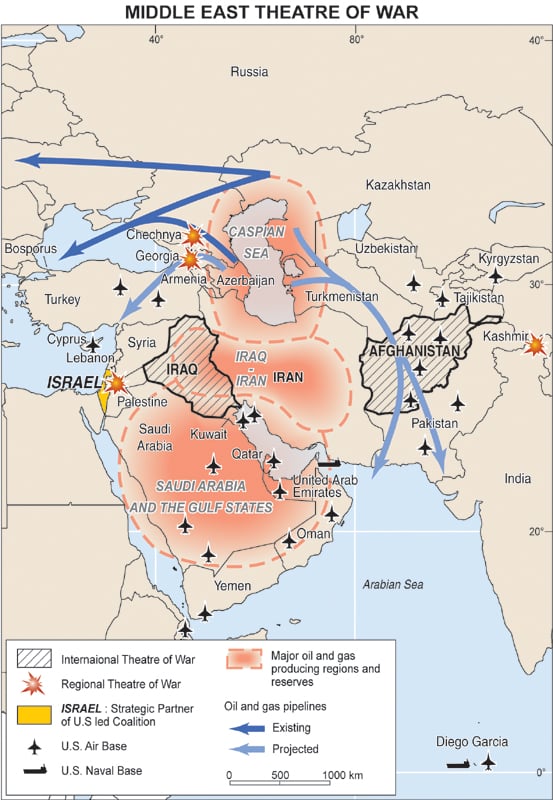
The US led war in the broader Middle East Central Asian region consists in gaining control over more than sixty percent of the world’s reserves of oil and natural gas. The Anglo-American oil giants also seek to gain control over oil and gas pipeline routes out of the region. (See table and maps below). 

Muslim countries including Saudi Arabia, Iraq, Iran, Kuwait, the United Arab Emirates, Qatar, Yemen, Libya, Nigeria, Algeria, Kazakhstan, Azerbaijan, Malaysia, Indonesia, Brunei, possess between 66.2 and 75.9 percent of total oil reserves, depending on the source and methodology of the estimate. (See table below).

In contrast, the United States of America has barely 2 percent of total oil reserves. Western countries including its major oil producers ( Canada, the US, Norway, the UK, Denmark and Australia) control approximately 4 percent of total oil reserves. (In the alternative estimate of the Oil and Gas Journal which includes Canada’s oil sands, this percentage would be of the the order of 16.5%. See table below). 

The largest share of the World’s oil reserves lies in a region extending (North) from the tip of Yemen to the Caspian sea basin and (East) from the Eastern Mediterranean coastline to the Persian Gulf. This broader Middle East- Central Asian region, which is the theater of the US-led “war on terrorism” encompasses according to the estimates of World Oil, more than sixty percent of the World’s oil reserves. (See table below). 

Iraq has five times more oil than the United States. 

Muslim countries possess at least 16 times more oil than the Western countries. 

The major non-Muslim oil reserve countries are Venezuela, Russia, Mexico, China and Brazil. (See table) 

Demonization is applied to an enemy, which possesses three quarters of the world’s oil reserves. “Axis of evil”, “rogue States”, “failed nations”, “Islamic terrorists”: demonization and vilification are the ideological pillars of America’s “war on terror”. They serve as a casus belli for waging the battle for oil.  

The Battle for Oil requires the demonization of those who possess the oil. The enemy is characterized as evil, with a view to justifying military action including the mass killing of civilians. The Middle East Central Asian region is heavily militarized. (See map). The oil fields are encircled: NATO war ships stationed in the Eastern Mediterranean (as part of a UN “peace keeping” operation), US Carrier Strike Groups and Destroyer Squadrons in the Persian Gulf and the Arabian deployed as part of the “war on terrorism”. 

USS Enterprise Strike Group

The ultimate objective, combining military action, covert intelligence operations and war propaganda, is to break down the national fabric and transform sovereign countries into open economic territories, where natural resources can be plundered and confiscated  under “free market” supervision. This control also extends to strategic oil and gas pipeline corridors (e.g. Afghanistan).  

Demonization is a PSYOP, used to sway public opinion and build a consensus in favor of war. Psychological warfare is directly sponsored by the Pentagon and the US intelligence apparatus. It is not limited to assassinating or executing the rulers of Muslim countries,  it extends to entire populations. It also targets Muslims in Western Europe and North America. It purports to break national consciousness and the ability to resist the invader. It denigrates Islam. It creates social divisions. It is intended to divide national societies and ultimately trigger “civil war”. While it creates an environment which facilitates the outright appropriation of the countries’ resources, at the same time, it potentially backlashes, creates a new national consciousness, develops inter-ethnic solidarity, brings people together in confronting the invaders. 

It is worth noting that the triggering of  sectarian divisions and “civil wars” is contemplated in the process of redrawing of the map of the Middle East, where countries are slated to be broken up and transformed into territories.  The map of the New Middle East, although not official, has been used by the US National War Academy. It was recently published in the Armed Forces Journal (June 2006). In this map, nation states are broken up, international borders are redefined along sectarian-ethnic lines, broadly in accordance with the interests of the Anglo-American oil giants (See Map below). The map has also been used in a training program at NATO’s Defense College for senior military officers. 

MAP OF THE NEW MIDDLE EAST


Map: click to enlarge

Note:
The following map was prepared by Lieutenant-Colonel Ralph Peters. It was published in the Armed Forces Journal in June 2006, Peters is a retired colonel of the U.S. National War Academy. (Map Copyright Lieutenant-Colonel Ralph Peters 2006).
The Oil Lies in Muslim Lands

The oil lies in Muslim lands. Vilification of the enemy is part and parcel of Eurasia energy geopolitics. It is a direct function of the geographic distribution of the World’s oil and gas reserves. If the oil were in countries occupied predominantly by Buddhists or Hindus, one would expect that US foreign policy would be directed against Buddhists and Hindus, who would also be the object of vilification.. 

In the Middle East  war theater, Iran and Syria, which are part of the “axis of evil”, are the next targets according to official US statements. 

US sponsored “civil wars” have also been conducted in several other strategic oil and gas regions including Nigeria, the Sudan, Colombia, Somalia, Yemen, Angola, not to mention Chechnya and several republics of the former Soviet Union. Ongoing US sponsored “civil wars”, which often include the channelling of covert support to paramilitary groups, have been triggered in the Darfur region of Sudan as well as in Somalia, Darfur possesses extensive oil reserves. In Somalia, lucrative concessions have already been granted to four Anglo-American oil giants.

“According to documents obtained by The Times, nearly two-thirds of Somalia was allocated to the American oil giants Conoco, Amoco [now part of BP], Chevron and Phillips in the final years before Somalia’s pro-U.S. President Mohamed Siad Barre was overthrown and the nation plunged into chaos in January, 1991. Industry sources said the companies holding the rights to the most promising concessions are hoping that the Bush Administration’s decision to send U.S. troops to safeguard aid shipments to Somalia will also help protect their multimillion-dollar investments there.” (America’s Interests in Somalia, Global Research, 2002)

Globalization and the Conquest of the World’s Energy Resources

The collective demonization of Muslims, including the vilification of Islam, applied Worldwide, constitutes at the ideological level, an instrument of conquest of the World’s energy resources. It is part of the broader economic, political mechanisms underlying the New World Order.


Michel Chossudovsky is the author of the international best seller “The Globalization of Poverty ” published in eleven languages. He is Professor of Economics at the University of Ottawa and Director of the Center for Research on Globalization, at   
www.globalresearch.ca . He is also a contributor to the Encyclopaedia Britannica.  His most recent book is entitled: America’s “War on Terrorism”, Global Research, 2005. 


Oil Reserves by Country 

(Proven reserves in billions of barrels)

Rank

Country

Percent of World Reserves

World Oil, December 2004

Percent of World Reserves

Oil & Gas Journal, January 2006 

1.

Saudi Arabia

24.2

262.1

20.6

266.8

2.

Canada*

0.4

4.7

13.8

178.8

3.

Iran

12.1

130.8

10.3

132.5

4.

Iraq

10.6

115.0

 8.9

115.0

5.

Kuwait

9.2

99.7

 7.9

101.5

6.

United Arab Emirates

6.5

69.9

 7.6

97.8

7.

Venezuela*

4.8

52.4

 6.1

79.7

8.

Russia

6.2

67.1

 4.6

60.0

9.

Libya

3.2

33.6

 3.0

39.1

10.

Nigeria

3.4

36.6

 2.7

35.9

11.

United States

2.0

21.4

 1.7

21.4

12.

China

1.4

15.4

 1.4

18.3

13.

Qatar

1.8

20

 1.2

15.2

14.

Mexico

1.4

14.8

 1.0

12.9

15.

Algeria

1.4

15.3

 0.9

11.4

16.

Brazil

1.0

11.2

 0.9

11.2

17.

Kazakhstan

0.8

9.0

 0.7

  9.0

18.

Norway

0.9

9.9

 0.6

  7.7

19.

Azerbaijan

0.6

7.0

 0.5

  7.0

20.

India

0.5

4.9

 0.4

  5.8

21

Oman

0.4.

4.8

 0.4

  5.5

22

Angola

0.8.

9.0

 0.4

  5.4

23

Ecuador

0.5

5.5

 0.4

  4.6

24

Indonesia

0.5

5.3

 0.3

  4.3

25

UK

0.4

3.9

 0.3

  4.0

26

Yemen

0.3

3.0

 0.3

  4.0

27

Egypt

0.3

3.6

 0.3

  3.7

28

Malaysia

0.3

3.0

 0.2

  3.0

29

Gabon

0.2

2.2

 0.2

  2.5

30

Syria

0.2

2.3

 0.2

  2.5

31

Argentina

0.2

2.3

 0.2

  2.3

32

Equatorial Guinea

0.2

1,8

 0.0

  0.0

32

Colombia

0.1

1.5

 0.1

  1.5

33

Vietnam

0.1

1,3


  0.6

34

Chad

0.0

0.0

 0.1

  1.5

35

Australia

0.3

3.6

 0.1

  1.4

36

Brunei

0.1

1.1

 0.1

  1.4

37

Denmark

0.1

1.3

 0.1

  1.3

38

Peru

0.1

0.9

 0.1

  1.0

Total Muslim Countries**

75.9

822.1

66.2

 855.6

Total Western World (EU, North America, Australia)

 4.1

 44.8

16.5

 213.3
Other Countries  20.6 214.9 17.3  223.6
World Total 100.0 1,081.8 100.0 1,292.5

Source: EIO: Energy Information Administration (Scroll down for explanatory notes on the table)


ANNEX
© Map by Eric Waddell, Global Research, 2003.  (click to enlarge) 

For details on th Campaign against the pipeline see
http://www.bakuceyhan.org.uk/more_info/bp_pipeline.htm
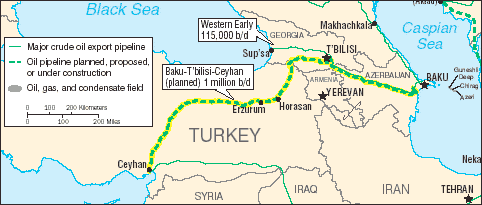
Route of the Baku-Tbilisi-Ceyhan pipeline


NOTES  PERTAINING TO THE TABLE ON THE DISTRIBUTION OF OIL RESERVES

Indicated are the world’s main oil reserve countries. Countries with less than 0.1 % of total reserves are not indicated.

The Oil and Gas Journal figures indicated above are based on proven oil reserves including the bituminous oil fields (oil sands or tar sands). The World Oil figures indicate oil reserves without the tar sands. The difference between the two sets of figures largely pertains to the position of Canada and Venezuela. The tar-sands are considered by some experts as not recoverable with present technology and prices, although this issue is the object of heated debate. 

Muslim countries are indicated in bold. Percentages are rounded up to first decimal. 

*Canada appears according to this estimate as the Second Country in terms of the size of proven reserves, due to the size of its bituminous oil fields. The Oil & Gas Journal’s oil reserve estimate above for Canada includes 4.7 billion barrels of conventional crude oil and condensate reserves and 174.1 billion barrels of oil sands reserves.

In other recognized estimates, where the oil sands are not accounted for, Canada’s reserves are much lower (in billions of barrels):  

BP Statistical Review 16.802 

Oil & Gas Journal 178.792

World Oil 4.700

BP notes that “the figure for Canadian oil reserves includes an official estimate of Canadian oil sands “under active development”.” BP says of its data sources for oil reserves that “the estimates in this table have been compiled using a combination of primary official sources, third-party data from the OPEC Secretariat, World Oil, Oil & Gas Journal and an independent estimate of Russian reserves based on information in the public domain.

World Oil’s Canadian oil reserve estimate “does not include 174 billion bbl [barrels] of oil sands reserves.”

Source

Posted in Economics, Empire | Leave a comment